Wednesday, December 9, 2015

Visiting The Tree Farm

For my field trip I decided to visit my local tree farm. During the summer, my town is known for the fruit stands lining the highway. You always get the best quality food and service from those little stands. Once Halloween is over all of them shut down because the season is over, except for one. Nielson's fruit stand is the only one that remains open until Christmas eve because they offer winter products, their most popular being Christmas trees. Everyone that buys real trees gets them from Nielson's because the owners are local and they're the best quality. My town is all about local business and anything that supports our small city.

 The Nielson's fruit stand is owned by very good friends of mine, the Tyler's. The wife, Jana, runs most of the business because her husband has another job in town. She is the sweetest lady that instantly makes you feel like you've known her for years. She has been working at the fruit stand ever since she was a little girl. It originally belonged to her father before he passed away.

Everyone shops at the Nielson's, you can find young and old people alike. Several of them grew up shopping there and will continue to teach their kids the joys of shopping at a locally grow market. Another great thing is the fact that everyone welcomes you with open arms. You don't feel like an outsider, even if it is your first time shopping there. Everyone is treated like family and that's one of the main reasons people keep on coming back.

I loved the experience I had going through the Nielson's and getting to know the staff. I grew up driving past it but never had the chance to stop by and go inside. It was a wonderful opportunity to get to know a huge part of my community and make a few new friends in the farming community.

Sunday, November 15, 2015

Our Good Earth

curry Our Good Earth


"Our Good Earth"  By John Steuart Curry 
Painted 1941, Kansas USA
Oil paint on canvas

I chose this picture because I loved how it included children. Typically, farm artwork does not include children and just focuses on the adults. This causes people to not think of farming as a family business, when in reality the children do just as much work as the adults. 

This picture shows several aspects of farming. The first thing I noticed when I saw it was the man with his two children. They are out in the middle of the field, probably getting ready to harvest the wheat. The father's face is extremely stern, possibly anticipating the harvest to come or perhaps he had a rough season. It shows that farming is unpredictable and requires a lot of dedication. The father is also wearing tattered clothing from all the hard work that needed to be done. The children are dirty as well, which implies that they help out with the farm work. It shows that farming requires the entire family to help and do their part. Another thing noticeable about this painting is the wind. You can tell it is blowing decently hard and it relates back to how farming is unpredictable. Every day you do not know what type of weather you are going to get and the affect it will have on your crop. Whether it is a good harvest or a bad one, you have to keep moving forward and stay dedicated to your lifestyle. 

Curry, John Steuart. Our Good Earth. 1941. Chazen Museum of Art, Madison, WI. Chazen Museum of Art. Web. 15 Nov. 2015.

Sunday, November 1, 2015

The American Dream

           Many small farms in the United States have struggled to make it in the new economic system. There is a small Maine company called Maine’s Own Organic Milk, or MOO Milk, that recruited those who lost their previous jobs to produce fresh, organic milk. This is one example of how farmers made it through the economical struggle. In the film, Betting the Farm, it depicts the life three dairy farmers and their struggle to keep their farms. The film is effective because it shows the American public how dedicated a farmer is to their profession and the hardship they have to endure to do the thing they love.
            In 2009, ten dairy farms in Maine were dropped by their milk company and no other companies would purchase their milk. Worried about how they were going to survive, they banded together to start their own milk company. In the film, it focuses on three families and their journey to begin this company. In the beginning, the company really struggles to find new customers to purchase organic milk over the cheaper alternative. Eventually the company does better but still does not break even.
            The film was a documentary following the progress of the milk company, but it did not have any narration. Without a narrator, it made it difficult to follow what was happening in these farmer’s lives. There was a significant amount of time where the audience was viewing it in a third person point of view, during which, it was extremely difficult to hear or understand what was taking place. I assume the filmmakers created it in this fashion to show the public raw, unedited footage of the life of an actual farmer. It is a great idea but could have been improved by adding a little narration to help the audience follow the storyline. The film, also, did not have any account for time other than the occasional subtitle that would appear. It would go from six months to a year in a couple seconds and it was confusing to comprehend what had occurred.
            The farmers in the film were very dedicated to their professions. It depicted several times where the company was not producing enough money to make a profit and to pay the farmer’s back for the milk and expenses that they were sacrificing for the small company. However, the farmers did not deviate in their dreams to keep their farming lifestyle alive. They did many things that most people would deem unnecessary or foolish just to keep this small business growing. One family even let their lease to their house fall behind and was endanger of their whole family being homeless. Another older couple eventually ends up leaving after around 20 months of the company being started because of them not getting their money for their product. The other nine partners stayed in for the whole documentary. By showing these examples, the public is able to see farmer’s commitment to their farms and the extremes they take to continue forward.
            Several of them were third and fourth generation dairy farmers, it is all they know how to do. It is not just an ordinary job where you work during the day and go home at night and not worry about it. It does not matter what time of day it is, they are farmers and it is their life. The film demonstrates, very clearly, how much work is put into a farm. No one truly understands how their lives are literally centered around their farm and this film perfectly depicts it. One farmer was up late into the night taking care of one his cows, even though he still had to wake up before sunrise to get started on his daily chores. The film illustrates how the life of a farmer is unpredictable but they work through those rough times, knowing the reward is well worth it.
            A few months after the company began, they started to get a lot of negative feedback from consumers. They thought it was a pointless venture and not very cost effective. Rumors began to spread that the dairy farmers, who were originally supposed to get 90% of the profits, were not getting any of the money. In a way, that is true but not for the reasons people thought. They were not getting paid for their milk but it was because they were not making enough money for the company to break even. This is a great example of how people have the wrong idea about farmers and the work they do. They do not know what to think of them, mostly because they have never seen what farmers actually do. Even though the film was poorly filmed and directed, it opened the eyes of the public to how difficult it is to put a new product out on the market and how much work goes into being a dairy farmer. It is exactly what consumers need to see in regard to what is in the products they are purchasing.
            The documentary, Betting the Farm, demonstrates to the American public how dedicated farmers are to their farms. It proves how farming is not just an occupation, but a lifestyle. In further research, I discovered MOO Milk was discontinued in May 2014 and disbanded that July. It goes to show that farmers never have an easy life. They never know when their profession is going to go out of business, but that does not keep them from moving forward. As a whole, the film has a great message about the devotion of farmers but it was poorly created and directed, leaving the audience confused and unsatisfied with the ending.

Sunday, October 25, 2015

The Farm Bill

The Farm Bill is an extremely important piece of legislation that connects us, our food and the farmers who grow it. It also involves the environment and what natural resources are used to grow the food we eat (What Is The Farm Bill). So in reality, the Farm Bill is really more of a food bill. The bill expires every five years so that it can be updated to suit what is currently happening in our country. More then fifty percent of the Farm Bill money goes to Supplemental Nutrition Assistance Progam (SNAP) to help Americans in need. In 2012, there were 46,000,000 Americans relying on SNAP to put food on the table (UC Berkeley). This is an important part of the bill, to help those in our country that need help obtaining food. Although the bill was created to help out the farmers and instead it is feeding people that may or may not need the extra help. Throughout all the years of the Farm Bill, a majority of the spending has been towards nutrition. The Farm Bill was designed to help the farmers and maintain farming in America but if anything it is hurting the country. The question people are asking is if it is time for agriculture to break free from the Farm Bill. The purpose behind the bill is great and the country really needs something to look out to those who put food on our tables but it does not seem that is the highest priority since most of the money goes into food stamps.

UC Berkeley. "The Farm Bill." Online video clip. YouTube. YouTube, 20 Sept. 2012. Web. 25 Oct. 2015.

"What Is The Farm Bill?" National Sustainable Agriculture Coalition. National Sustainable Agriculture Coalition, n.d. Web. 25 Oct. 2015.

Sunday, October 11, 2015

Farm Forklore

For my folklore piece I decided to use a folksong in our textbook titled, The Country Life. It is a song about the farm life year round and how they have to work hard no matter which season it is (Farm: A Multimodal Reader). It can be hard to tell if folklore is farm related because a lot of them generally have to do with farming. At least when I think of folklore, I think of stories told by farmers to their sons, passed down generation by generation. That is not always true though.

This folksong is quite obviously about farms. You can tell just by reading the title, The Country Life. Country life and farm life are commonly used interchangeably. By the end of the first line, you know they like to rise early in the morning, which is an essential characteristic of farmers. There are plenty of other jobs that require you to wake up early in the morning, often before the sun rises, but most of the time it is because you have to, not because you enjoy it. I have known a few farmers in my life and all of them have been morning people, they enjoy getting up before the sunrises and starting their day off early.

There are about six verses to this song, each repeating the chorus. The first four versus are about the seasons of the year and what work a farmer has to attend to. It begins with spring, describing how it is filled with sowing their harvest. It is by far the busiest time of year for them but it is what they prepare for year round. The next is about winter and preparing for the spring to come. Summer is by far the most relaxed season. They celebrate the closing of spring and all the hard work they accomplished. Autumn they are just preparing for the cold winter months by gathering wood.

This entire song is depicting the life of a farmer and how it is a year round job. It shows how hard it is to be a "country boy" but it is also extremely rewarding.

References:
Kinkead, Joyce, Evelyn Funda, and Lynne S. McNeill. Farm : a multi-modal reader. Southlake, TX: Fountainhead Press, 2014. Print.

Sunday, September 27, 2015

Tracing Cotton Roots

For this assignment I decided to research where the cotton from Nike comes from. I looked at the material my Nike socks are made out of and it has 58% cotton, 39% nylon, and 3% spandex. As Nike is one of the largest clothing manufacturers in the United States, I thought it would be beneficial to know where so much of the country's gross economical material comes from.

In 2001, Nike set a goal to integrate at least 5% organic cotton into their conventional cotton by 2011 and then another for 10% by 2015 (Environmentally Preferred Materials). They used over 21 million pounds of organic cotton fiber in their products last year, placing them as the third-largest retail user of organic cotton in the world. The source of their cotton, in the case of my socks, was made in Pakistan. It is one of the largest cotton producers in the world but their production process can have terrible environmental impacts. They irrigated weekly and used fertilizers and pesticides whenever they irrigated. In 2006, World Wildlife Federation started a project that encouraged better ways to grow cotton. Now Pakistani farmers have reduced their use of water by 37%, pesticides by 47%, and chemical fertilizer by 40% (Better Cotton). Now they only irrigate and fertilize when they need to.

Now that I have researched and learned how Nike obtains their cotton, I feel much more comfortable buying their products. A big concern now is how much Americans, or the world in general, are wasting products and how it is affecting the earth. Nike is striving to use materials that is good for the environment, instead of trying to make the most money. The cotton production in Pakistan is also making an effort to find more effective ways to harvest their crop. It would definitely influence my decision in buying something if it was a cotton product made in Pakistan. It all begins at the farm, and if they are working to help the environment then the rest of company is mindful of the environment.

References:
"Environmentally Preferred Materials." Nike, Inc. Nike, Inc. Web. 27 Sept 2015.
"Better Cotton." WWF Global. WWF Global. Web. 27 Sept 2015.

Friday, September 11, 2015

Roots: Farming In The 1920's

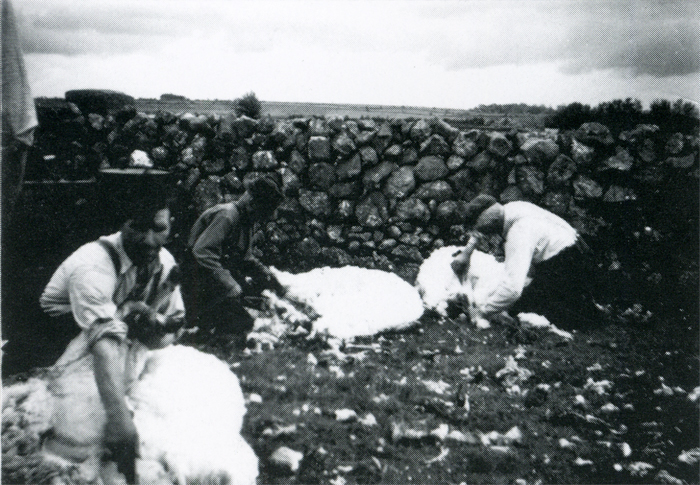
I do not have any farmers in my immediate family and had to do a little digging into my family tree to find any. I was finally able to find one of my ancestors, Niels Christensen. He lived during the 1920's in a small town in southern Utah. He had an extremely successful sheep farm, where he sold their wool, until the 1920's crashed and the agricultural business dropped. When the depression was in full swing, he had difficulty feeding his wife and seven children, so he worked in the mines in addition to running his sheep farm in order to be able to put the food on the table. Luckily for him he had five sons that could help him with all the farm work instead of having to hire extra hands, which he would not be able to afford. He fought hard to keep his farm because it had been in his family for generations, even if it meant working long hours in the mines to keep it barely afloat.


The Ag classroom timeline mentioned the life on the farm and what technological advances happened in the home (Historical Timeline). It named two advances, the first about movie houses being common in rural areas. Then the second was how broadcast radio began during the 1920's. In my ancestor's home, they spent their nights listening to the radio as a family to unwind after a long days work on the farm. It was their way of spending time together and to talk about what was going on in their children's lives.

Looking at the Ag classroom timeline, I was surprised to see how much of it connects to my ancestors personal lives. The first thing listed is the collapse of agricultural prices and then long-term agricultural depression, which is exactly what my ancestors went through (Historical Timeline). They were having complete success before the 1920's and then it dropped suddenly and never really came back up. Unfortunately, they had to sell their farm around 1928 because Niels grew extremely ill and wasn't able to keep working out in the fields. The depression for farmers lasted twenty years and Niels never lived long enough to see it end. He passed away in 1931, nine years before the depression ended. 

References:
"Historical Timeline-1920." Growing a Nation. Utah State University, 2014. Web. 11 Sept 2015.